Culpeper Minute Men: Icons of Independence
The Largest Muster and Deployment site in 1775 Virginia: Clayton’s Old Field (now Yowell Meadow Park)
Written by: Jim Bish
On the onset of Virginia’s Revolutionary War in 1775, Virginia Patriots were forced into the conflict, facing off against Virginia’s Royal Governor Lord Dunmore and his British and Loyalists forces in Virginia. After the Battle of Bunker Hill Virginia’s 3rd Convention in August 1775 set the framework for a real Virginia military force as they divided Virginia into sixteen military districts and created the 1st and 2nd Virginia Regiments. Each military district was to create one regular company of 68 men, to be attached to either the 1st or 2nd Virginia Regiment and each military district was also to create 10 companies of 50 men each formed into a minute battalion. The purpose of the regular company was to be deployed wherever Virginia’s leaders felt they were needed as part of the 1st or 2nd Virginia regiments. The minute battalions were primarily formed for regional and local defense. Fauquier, Orange and Culpeper counties formed what was called the Culpeper Military District as Culpeper was the centrally located county and it was from there that the regular company and minute battalion mustered, drilled, and deployed. Military leaders from Orange, Fauquier, and Culpeper decided to recruit in those counties in August and bring their recruited men to Culpeper Courthouse for the muster set for September 1, 1775. The location they set to muster was known as Major Philip Clayton “old field” (now Yowell Meadow Park) which was a level area adjoining Mountain Run on the eastern end of Clayton’s Catalpa property. It appears that Major Philip Clayton’s “old field” was the regular mustering and drill location for the local Culpeper militia, probably going back to 1749.
Philip Clayton was the eldest son of Samuel and Elizabeth (Pendleton) Clayton. He married Ann Coleman, sister of Robert Coleman who owned the land Culpeper was founded on. To this union at least three children were born including Lucy Clayton who married town trustee and neighbor William Williams; Samuel Clayton who lived on the Mountain Run property; and Susannah Clayton who married James Slaughter. Prior to 1745 Philip removed with his close family members, the Colemans and Pendletons to Orange County where they resided in the portion known as St. Mark’s Parish, which was included in Culpeper County in 1749. Philip Clayton was elected a member of the vestry in that Parish, and served as a vestryman for many years. He was church warden in 1763, and resigned from the vestry in 1766. When Fairfax (now Culpeper Court House), was laid out in 1759, he was made one of its original trustees. He was deputy to the first clerk of Culpeper County, Roger Dixon, and performed most of the duties for Dixon, who lived a majority of the time in Fredericksburg. Clayton’s estate was near the Court House in Culpeper County, and was named Catalpa. It is said from a catalpa tree which he had transplanted from Essex County, which was the first of that kind brought to this locality. It was in the old field at Catalpa where the first encampment of the Culpeper minute men drilled in preparation for service in the Continental army.
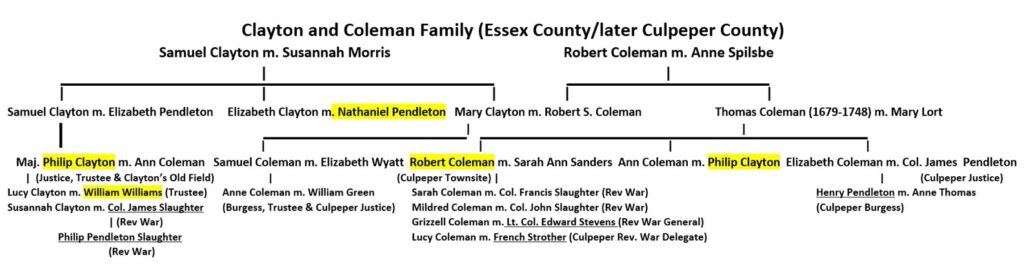
The above individuals highlighted in Yellow all owned adjoining properties at and surrounding Culpeper Courthouse. Major Philip Clayton brother-in-law was Robert Coleman who donated the land for the townsite of Culpeper Courthouse, later known as the town of Fairfax and currently Culpeper. Philip Clayton’s uncle was Nathaniel Pendleton who lived on the adjoining property of Redwood. William Williams was Clayton’s son-in-law as was Culpeper Minutemen Col. James Slaughter. Clayton’s grandson, Philip Slaughter was a sixteen-year old recruit of the Culpeper Minutemen in 1775 and kept a diary of the muster, drill, and deployment. In addition the highest ranking officer from Culpeper was during the Revolutionary War was Gen. Edward Stevens who was the nephew of Major Philip Clayton. Culpeper’s Revolutionary War politicians Henry Pendleton and French Slaughter were also nephews to Clayton.
Homesites and approximate landholdings for Robert Coleman, William Williams, Philip Clayton, and Nathaniel Pendleton
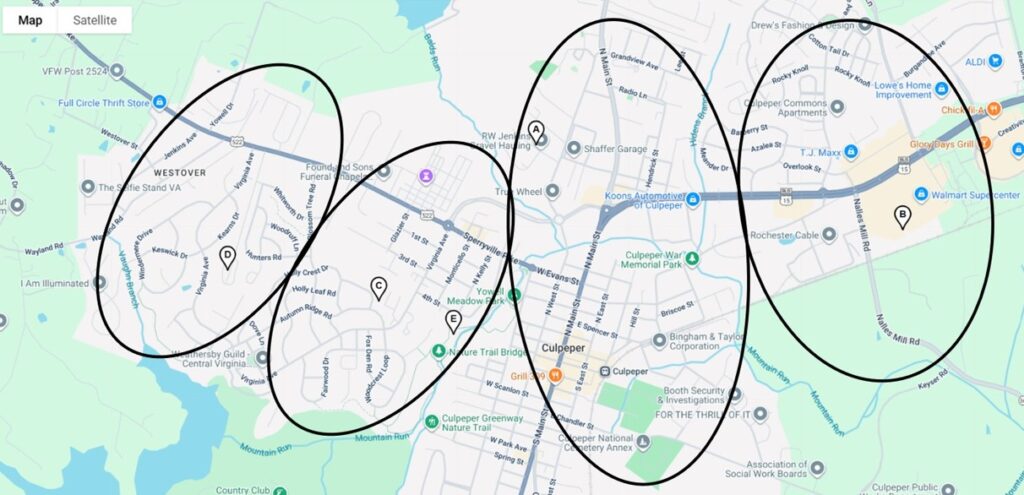
A. Robert Coleman’s homesite of Fairview and his approximate land holdings. Coleman owned the land that the Culpeper Courthouse was built and later donated the land for the town of Fairfax (now Culpeper) in 1759. Coleman’s son-in-laws were General Edward Stevens and French Strother.
B. William Williams’ homesite of Cedar Farm and his approximate land holdings. Williams served as an original Fairfax town trustee and was one of the sixteen justices who resigned during the Stamp Act Crisis of 1765. Williams had a son who served as an officer in the Culpeper Minute Battalion and later in the Continental Army.
C. Major Philip Clayton’s homesite of Catalpa and his approximate landholdings. The Culpeper muster site (E.) was on the eastern edge of Clayton’s property along Mountain Run, now located within Yowell Meadow Park. Philip Clayton served as an original Culpeper County Justice in 1749 and an original Fairfax town trustee in 1759. He rose to the rank of Major in the Culpeper Militia.
D. Nathaniel Pendleton’s homesite of Redwood and his approximate land holdings. Pendleton served Culpeper as a Culpeper County Justice and was one of the sixteen justices who resigned during the Stamp Act Crisis of 1765. His son Nathaniel Jr. served as an officer in the Continental Army.
Preparation to meet at Clayton’s Muster Location
In the newly formed Culpeper Military District (made from Fauquier, Orange, and Culpeper Counties) local leaders met and made commitments for recruiting individual companies and decided to meet on September 1st in the central county of Culpeper at the traditional militia muster site of Philip Clayton’s property just west of Culpeper Court House. It seems clear that some of the most experienced riflemen and former militia veterans would make up the district’s needs for the 68-man rifle company that would be incorporated into either Patrick Henry’s 1st Virginia Regiment or William Woodford’s 2nd Second Virginia Regiment. Because of its size, recruitment for the manpower needs for the ten-company minute battalion was going to be the greatest challenge.[1]
In Fauquier County, Delegates Thomas Marshall and James Scott began recruiting officers and in turn, those officers were charged with recruiting the needed manpower for each company to fulfill Fauquier’s obligations. Besides Marshall and Scott, officers placed in charge of recruiting their own companies included William Pickett, John Chilton, William Blackwell, George Johnston, Elias Edmunds, Francis Triplett, and William Payne. Orange County leaders Lawrence Taliaferro, Richard Taylor, Joseph Spencer, John Williams, and Willliam Taliaferro began recruiting their own companies. In Culpeper County, highest ranking militia officers, John Green and Edward Stevens, took the lead in recruitment efforts. Other Culpeper leaders recruiting included Abraham Buford, John Jameson, William McClanahan, George Slaughter, Philip Clayton, and James Slaughter. Their upcoming muster on September first at Clayton’s Field would determine how effective their August recruitment efforts were.[2]
As the September 1, 1775 rendezvous of the Culpeper Military District approached, recruiting captains from each of the three counties of Orange, Culpeper, and Fauquier made plans to meet at Clayton’s muster field along Mountain Run. It appears that each recruitment captain had their specific region in which they recruited. In Culpeper: Abraham Buford recruited in southwestern Culpeper County (today’s Madison County); John Jameson Culpeper Courthouse; William McClanahan in northwestern Culpeper County and today’s Rappahannock County; James Slaughter and Edward Stevens in the area of Culpeper Courthouse and south and east to the Rapidan River; and John Green in the northeastern areas of the county.
In Orange, Joseph Spencer recruited in the southeastern area of the county. His recruiting journey to Clayton’s muster field has been recorded. Spencer made an initial rendezvous with his recruits at “Porter’s Old Courthouse” probably on August 31st. In 1775 this property was owned by Charles Porter and it had been the site of the first Orange County Courthouse from 1738 until 1749 when the courthouse was moved to near present-day Orange. The first courthouse location is on the east side of today’s Route 522 just northeast of E.V. Baker’s Store. From there, it is roughly 12 miles to Clayton’s muster field, about a half-day march. It is assumed that other recruiters rendezvoused in a similar fashion, however many of the recruiters in Culpeper County probably sent word to meet at Clayton’s field.
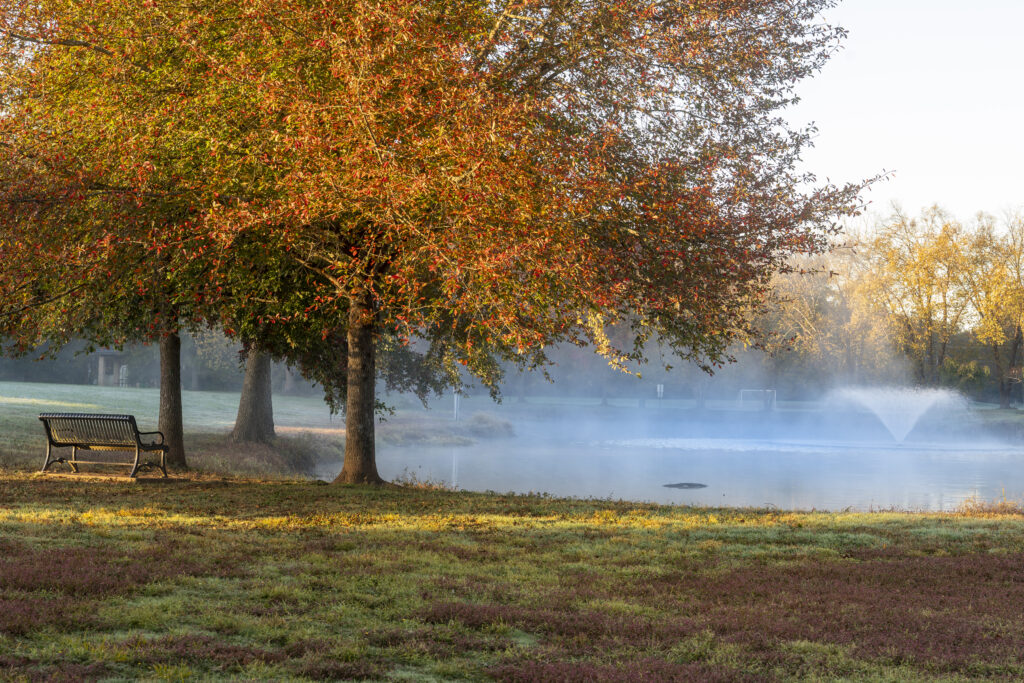
“Major Philip Clayton’s Old Field” in 1775 is now Yowell Meadow Park. It was the largest muster, drill, and deployment site in Virginia. Two battalion captains, John Chilton and James Scott, did not survive the war after beginning their Revolutionary War service from this field.
Arrival and activities at Clayton’s muster site in September 1775
Most of the Culpeper Military District recruits likely arrived by September 1, but some probably filtered in over the next few days. There the recruited men would have been sworn in, given rank, and told their paygrade. The Committee of Safety would have also been involved in fulfilling the officer ranks and in reducing the number of minute battalion companies and captains to ten. Some of the recruiting captains filled senior officer ranks and their recruits were assimilated into other companies to complete their needed numbers. Certainly, rifle competitions were held and most of those who were most skilled were put into John Green’s Rifle Company. There appears to have been enough good riflemen above the 68 needed for the rifle company and they were placed in a variety of the battalion companies. John Green of Culpeper County led the rifle company as Captain with Richard Taylor of Orange 1st Lt. and John Eustice of Fauquier as 2nd Lt. The senior leaders of the Minute Battalion were Col. Lawrence Taliaferro from Orange, Lt. Col. Edward Stevens from Culpeper, and Major Thomas Marshall from Fauquier. The ten Battalion Company Captains included Abraham Buford, John Jameson, and William McClanahan, all from Culpeper; William Blackwell, John Chilton, William Pickett, William Payne, and James Scott from Fauquier; and John Williams and Joseph Spencer of Orange.[3]
Once John Green’s Rifle Company was complete, which only took days, they marched to Virginia’s main staging area of Williamsburg known as College Camp, now known as the Sunken Garden west of the Wren building. Green’s company was the first to arrive in Williamsburg in mid-September, resulting in Green’s Culpeper Company being named the senior company of the 1st Virginia Regiment under Col. Patrick Henry. They were immediately pressed into service guarding the James River crossings that lead into Williamsburg and other Patriot trading routes against Lord Dunmore’s British and Loyalists attacks and takeover. Green’s riflemen quickly became the most important Company charged with keeping supply lines open to towns and cities on both sides of the James River including Williamsburg. In a letter from Virginia Committee of Safety Chairperson Edmund Pendleton to Thomas Jefferson, Pendleton stated, “The life and Soul of this Corps is Capt. Green’s Company of Riflemen from Culpeper.”[4]
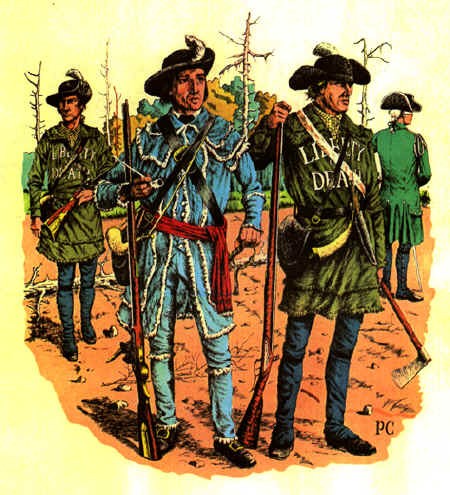
According to Culpeper’s Ensign David Jameson, the Culpeper Minute Battalion “was raised in less than three weeks.” Filling the ranks of the 500+ manned Minute Battalion took longer than to fill the 68-man Rifle Company. Back at Culpeper Courthouse, the senior leaders of the Minute Battalion were named as Col. Lawrence Taliaferro from Orange, Lt. Col. Edward Stevens from Culpeper, and Major Thomas Marshall from Fauquier. The ten battalion company captains were selected included Abraham Buford, John Jameson, and William McClanahan, all from Culpeper; William Blackwell, John Chilton, William Pickett, William Payne, and James Scott from Fauquier; and John Williams and Joseph Spencer of Orange. Nineteen-year-old John Marshall was made a Lieutenant in William Pickett’s Company. Sixteen-year-old-Culpeper County recruit, Philip Slaughter penned a diary account from which we get an image of how Clayton’s muster site appeared. Young Slaughter was the grandson of Philip Clayton and he knew the property well as his parents, James and Susannah (Clayton) Slaughter had earlier lived near the site.
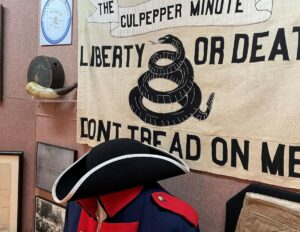
“Some had tents, and others huts of plank, etc. The whole regiment appeared according to order in hunting shirts made of strong, brown linen, dyed the color of the leaves of the trees, and on the breast of each hunting shirt was worked in large white letters the words, ‘Liberty or Death’ and all that could procure for love or money bucks’ tails, wore them in their hats. Each man had a leather belt around his shoulders, with a tomahawk and scalping knife. The flag had in the center a rattlesnake coiled in the act to strike. Below it were the words, ‘Don’t tread on me.’ At the sides, ‘Liberty or Death’ and at the top, ‘The Culpeper Minute Men.”[5]
Evidently Virginia Colonel Patrick Henry who headed all military personnel in Virginia became worried about the slowness of arriving Companies from the many Military Districts throughout Virginia. Meanwhile, news of the naval river attacks upon towns in Massachusetts was unsettling as were reports that more and more Loyalists were joining Lord Dunmore’s British forces in southeast Virginia. By mid-October only eight (Culpeper, Amelia, Gloucester, Princess Anne, Prince William, Elizabeth City, Caroline, and Lancaster) of Virginia’s 16 Districts Companies had arrived in Williamsburg and Henry realized that his military regiments were only half-strength. It was at this time that news reached him that the Culpeper Minute Battalion had fully formed with ten companies and officers.
Deployment from Clayton’s muster site and its importance to the liberation of Virginia.
Although the minute battalions were meant to serve as a regional defensive force, Patrick Henry made the decision for the Culpeper Minute Battalion to deploy. Young Culpeper recruit Philip Slaughter penned in his diary, “During our encampment an express arrived from Patrick Henry, commandant of the First Virginia Continental Regiment, by order of the committee of safety, then sitting in the city of Williamsburg, requesting the Minute Men to march immediately to that city. The Minute Men immediately made ready.” This resulted in the over 570 privates and officers marching off of Clayton’s Old Field for the 140 mile week-long march.
Between mid-September and mid-October 1775, over 650 Culpeper Military District recruits marched from the muster and drilling site of “Clayton’s Old Field” in response to Patrick Henry’s request of immediate mobilization to Williamsburg for the protection of Virginia. The Culpeper deployment proved to be by far the largest and most consequential from any location in Virginia in 1775-76 to answer the call of defending the Commonwealth from the British. While every Virginia Military District eventually fulfilled their requirements for a regular company, Culpeper’s “Minutemen” were Virginia’s only fully-manned minute battalion to respond in Virginia’s critical hour of need.
Philip Clayton’s Old Field (now Yowell Meadow Park) is hallowed ground. Revolutionary War historian Dr. Patrick Hannum stated it this way, “the five months (October 1775-February 1776) shaped the campaign in favor of the Patriots and contributed to the complete liberation of Virginia from royal colonial governance during the summer of 1776. The Culpeper Battalion was a major contributor to this effort and stands above other military districts in the impact they had on the campaign of 1775 and early 1776.” Countless men who marched from the hallowed Culpeper muster site in 1775 did not live to see the war’s end, including two Culpeper Minutemen Captains, John Chilton and James Scott.
[1] Green, Raleigh Travers. Genealogical and historical notes on Culpeper County, Virginia, a revised edition of Philip Slaughter, History of St. Mark’s Parish Culpeper Virginia. (Culpeper, Virginia: Green Printing, 1900), 45-48.
[2] T. Triplett Russell and John K. Gott. Fauquier County [Virginia] in the Revolution. (Westminster, Maryland: Heritage Books, Inc., 2007), 10-35; Thomas, William H.B. Patriots of the Upcountry – Orange County, Virginia in the Revolution (Orange, VA: Orange County Bicentennial Commission, 1976), 8-34.
[3] Jones, Mary Stevens. An 18h Century Perspective: Culpeper County. (Culpeper, VA: Culpeper Historical Society, Inc., 1976), 15-28.
[4] Tarter, Brent. “The Orderly Book of the Second Virginia Regiment: September 27, 1775-April 15, 1776.” The Virginia Magazine of History and Biography 85, no. 2 (1977): 174. http://www.jstor.org/stable/4248118.
[5] Green, Raleigh Travers. Genealogical and historical notes on Culpeper County. 46-48.