Culpeper Minute Men: Icons of Independence
A Most Important Culpeper Location – The 1750-1808 Courthouse at Main and Davis
Written by: Jim Bish
One of the most important historic locations in the history of Culpeper County is the northeast corner of Main (Coleman) Street and Davis Streets, now the site of the Pepperberries building at 102 E Davis Street. In late 1748 the House of Burgesses passed a resolution creating Culpeper County out of a portion of Orange County which was separated in 1749. One of the most important early decisions for the County Court Justices was where to establish the courthouse. The location for the site was probably decided by the site’s landowner, Robert Coleman; Coleman’s brother-in-law, bordering landowner, and county justice Philip Clayton, and newly appointed Culpeper County Surveyor, seventeen-year-old George Washington. The Courthouse, Jail, and Clerks Office were thought to be laid out by Washington as normal duties of a County Surveyor in July 1749 assisted by Coleman and Clayton. The Culpeper Courthouse Building was completed in 1750 and between 1749 and 1750 the court was held at the house of Robert Coleman (present day Fairview). From the presence of the Culpeper County Courthouse, businesses gradually formed nearby and the official town of Fairfax was created ten years later (1759) by the House of Burgesses which sited the towns location as a “High and Pleasant Situation” anchored by the courthouse. The town’s ten blocks and forty lots were laid out around the courthouse which sat atop a hill overlooking Mountain Run and the Blue Ridge Mountains to the west. At the time builder Benjamin Davis was leasing much of the land around the courthouse resulting in Davis being named to the East to West street just to the south of the courthouse. The main South to North street through the town, on the west side of the courthouse was called Coleman Street after the original landowner, Robert Coleman. That first courthouse (1750-1808) was made of wooden frame construction and many of the most important early events in Culpeper County’s history occurred there.
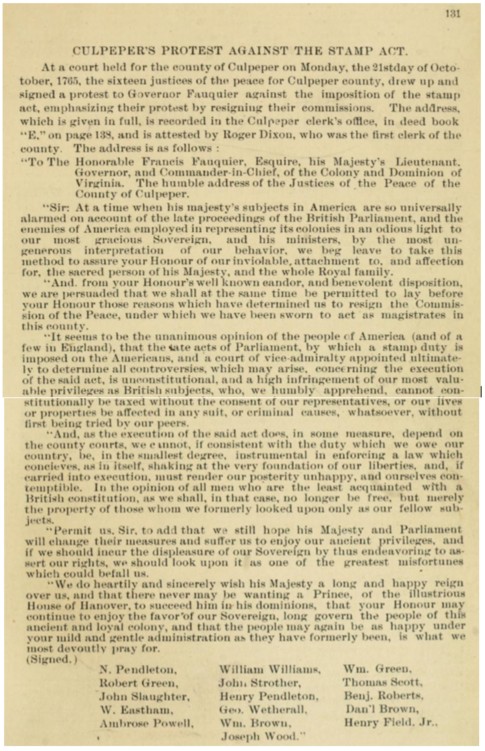
The 1765 Stamp Act Protest
On March 22, 1765 Parliament passed the Stamp Act which created a significant duty on paper goods ranging from legal documents to playing cards and more importantly American colonists had no say in its passage which created an immediate firestorm of rebellion in all of the colonies, especially Virginia. In the House of Burgesses Patrick Henry offered a number of resolves against the Act, and on May 30, 1765 the House ultimately passed four of them. Many county courts, led by Northampton County refused to open their courts thinking that if the courts did not open, they would not have to apply the tax. This quickly became problematic as local disputes, unassociated with needing a stamp, needed resolved by the courts. Realizing this, the justices in Westmoreland County on September 24, 1765, opened their court but reached the opinion that the Stamp Act by Parliament was unjust and therefore unconstitutional. In each of these instances, the local courts could be held accountable for derelict of their judicial duties. On October 21, 1765 Culpeper’s County Court Justices met at the courthouse and protested in a new way, which they felt was legal. Sixteen of the twenty Culpeper’s sixteen court justices resigned their office. There was nothing illegal about justices resigning which put the burden upon Governor Fauquier to replace Culpeper’s justices knowing that there were very few Culpeper residents with the qualifications needed for the courts. Culpeper’s protesting justices included Nathaniel Pendleton, Robert Green, John Slaughter, William Williams, Wm. Eastham, Ambrose Powell, John Strother, Henry Pendleton, George Weitherall, William Brown, Joseph Wood, William Green, Thomas Scott, Benjamin Roberts, Daniel Brown, and Henry Field Jr. On February 27, 1766 over 115 gentlemen, from nearby counties − Middlesex, Essex, Caroline, Spotsylvania, Stafford, Prince William, Fredericksburg, King George, Westmoreland, Northumberland, Richmond and Lancaster, led by Richard Henry Lee, met at Leedstown, Westmoreland County and signed what they called the Leedstown Resolutions in protest of the Stamp Act. The protests worked as on March 18, 1766 Parliament officially repealed the Stamp Act and Culpeper’s sixteen justices were reinstated. Culpeper remained one of only a few Virginia counties that demonstrated a creative protest during the crisis.
The 1774 Culpeper Resolves
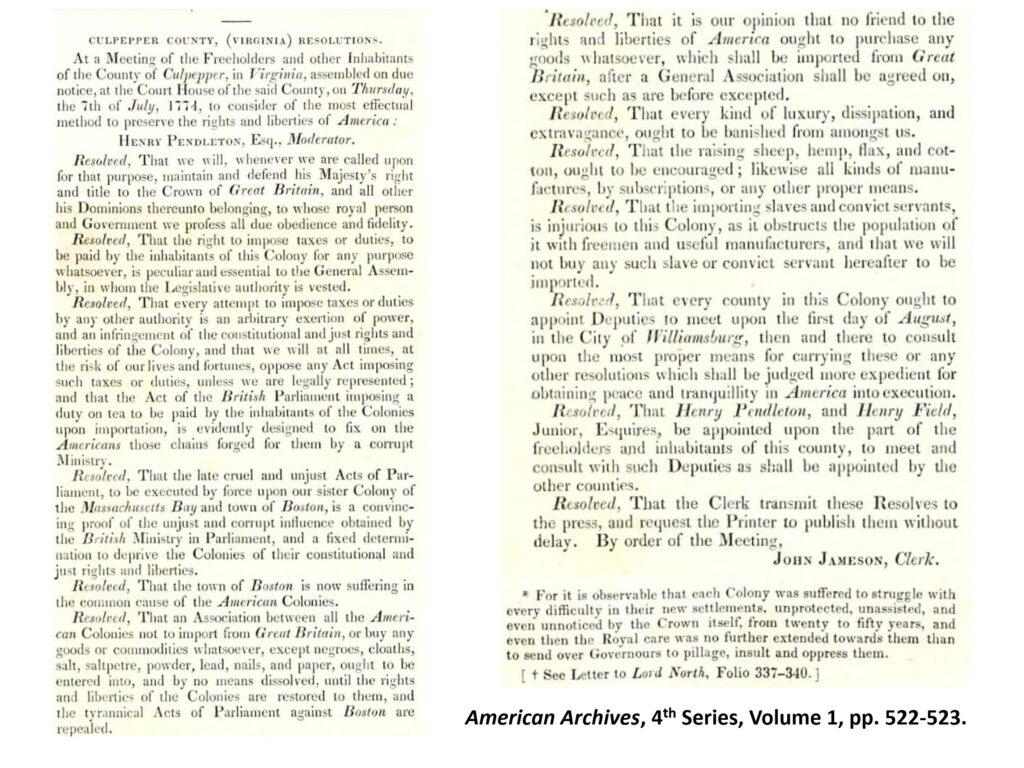
On July 7, 1774, Culpeper’s freeholders and inhabitants came together at the Culpeper County Courthouse to discuss and write a set of resolutions defiant of the British Parliament and Royal Governor Dunmore. These were some of the most important political actions ever made by Culpeper residents. The Resolves were in response to the passing of the Boston Port Act by Parliament. Responding to Parliament’s action, Virginia’s House of Burgesses which included Culpeper’s burgesses Henry Field and Henry Pendleton, passed legislation on May 24, 1774 designating 1 June 1774 a Day of Prayer stating, “the hostile invasion of the city of Boston, in our Sister Colony of Massachusetts bay, whose commerce and harbor are to be stopped by an Armed force, deem it highly necessary that the said first day of June be set apart, by the members of this House, as a day of fasting, humiliation, and prayer.” Two days later (May 26), when Governor Dunmore learned of the burgesses actions, he dissolved the House of Burgesses. This proved to be the final time the House of Burgesses, which began in 1619 would function. Eighty-nine of the 122 burgesses retreated to Raleigh’s Tavern in Williamsburg to set their course. Those 89 former burgesses signed an Association which committed to help the citizens of Boston and called for the formation of a Continental Congress. Both, Culpeper’s Field and Pendleton signed this document. Five days later, on May 31, Virginia’s Committee of Correspondence in Williamsburg sent a circular to each Virginia county inviting, “all the Members of the late House of Burgesses to a general Meeting in this City on the first Day of August next. We fixed this distant Day in Hopes of accommodating the Meeting to every Gentleman’s private Affairs, and that they might, in the mean Time, have an Opportunity of collecting the Sense of their respective Counties.” The Freeman and Inhabitants of Culpeper County responded to that request.
Between June and August 1774 residents from at least 45 of Virginia’s 61 individual counties met and wrote resolves reflecting their thoughts concerning Parliament, The King, and the actions Virginians needed to take. Culpeper became the tenth of at least 45 Virginia counties to draft resolves as residents met at Culpeper Courthouse on July 7, 1774 to debate and write down their sentiments. At the time of drafting Culpeper’s Resolves, Henry Pendleton Jr. served as the most important political leader of Culpeper County. He had served as the senior burgess from Culpeper County since 1769. Henry was the son of James and Elizabeth (Coleman) Pendleton and the nephew of Edmund and John Pendleton who also served in the House of Burgesses. Edmund served from Caroline County and John from King and Queen County. By far, the most important was Edmund as he was one of Virginia’s most important leaders. Edmund was selected by the Virginia Delegation to the Continental Congress in 1774 and later presided over the May 1776 Virginia Convention which authorized Virginia’s delegates to propose a resolution to move for the break from Britain and create a Declaration of Independence. In the autumn of 1776, Pendleton became the first Speaker of Virginia’s House of Delegates and he later served as president of the Virginia Convention of 1788 that ratified the Constitution of the United States. Culpeper’s Henry Pendleton served as moderator at the Culpeper Resolves meeting of Freeholders and Inhabitants who met on July 7 at the courthouse. Their objectives were “to consider the most effectual methods to preserve the rights and liberties of America.” Some important highlights of the Culpeper County Resolves included their support of Boston in their suffering for disobeying the unconstitutional act by Parliament; defending the Right for Virginians to be governed and taxed by themselves; Culpeper’s residents vowed to stop imports from and exports to Great Britain; and resolved to become more self-sufficient economically. Culpeper inhabitants were the first among the Virginia counties calling to end slave and convict importation. Culpeper’s freeholders stated, “that the importing of slaves and convict servants, is injurious to the colony, as it obstructs the population of it with freemen and useful manufacturers, and that we will not buy any such slave or convict servant hereafter to be imported.” Only five, (Caroline, Surry, Fairfax, and Princess Anne in addition to Culpeper) of the 32 surviving Virginia County Resolves called for ending the importation of slaves. Culpeper residents also used some bold statements of how far they would go against Parliament’s actions. Only Culpeper, Essex, and Fairfax County joined Loudoun County’s earlier sentiment using the phrase similar to risking their lives and fortunes to oppose acts by Parliament. Culpeper County’s Resolves probably said it best, “that we will at all times, at the risk of our lives and fortunes, oppose any act imposing such taxes or duties.”
On July 7, Culpeper’s residents made it known that they were not willing to accept any restrictions of their rights and liberties. Culpeper and most of Virginia’s residents responded to the erosion of those constitutional protections in a very unique display of democratic actions during the summer of 1774 to protect those rights. These democratic actions were Virginia’s first step to declaring independence two years later. Virginia’s and Culpeper’s Freeholders displayed the purest form of democracy and direction to their county representatives. At the courthouse that day, Culpeper’s residents responded with the most democratic actions known, before or after, as they prepared for the First Virginia Convention and the First Continental Congress.
The 1776 Reading of the Declaration of Independence
In the two years between July 1774 and July 1776 many events took place impacting Culpeper, Virginia, and all the American colonies. They included Virginia’s First Convention in Williamsburg (August 1–6, 1774); First Continental Congress met in Philadelphia (September 1774); Virginia’s Second Convention met in Richmond where Patrick Henry delivered his “Give me liberty, or give me death!” speech, persuading the convention to put the colony into a state of defense (March 20–27, 1775); Battles at Lexington and Concord, Massachusetts (April 19, 1775); Williamsburg, Virginia Gunpowder Incident (April 20, 1775); Second Continental Congress met in Philadelphia (May 1775); Continental Army created and Washington selected as Commander (June 14-15, 1775); Battle of Bunker Hill (June 17, 1775); Virginia’s Third Convention met in Richmond and established a formal Committee of Safety to govern and organized the military into sixteen Virginia military districts requiring each to district to provide one company to complete a First and Second Virginia Regiment and required each district to complete a 10-company minute battalion (July 17–August 26, 1775); Defense of Hampton (October 26–27, 1775); Virginia’s Fourth Convention met in Williamsburg (December 1, 1775–January 20, 1776); Battle of Great Bridge (December 9, 1775); Burning of Norfolk (January 1–3, 1776); Virginia’s Fifth Convention (May 5–July 6, 1776): The most pivotal gathering, which effectively declared Virginia an independent commonwealth. On May 15, delegates voted unanimously to instruct Virginia’s delegates at the Continental Congress to propose independence, which Richard Henry Lee performed. They also adopted the historic Virginia Declaration of Rights and drafted a new state constitution, paving the way for the creation of the United States. Of these Culpeper residents and leaders were most impacted by the creation of the sixteen military districts by Virginia’s Third Convention. This lead directly to the formation of the Culpeper Rifle Company, which was attached to the First Virginia Regiment and the Culpeper Minute Battalion which was attached to the Second Virginia Regiment. The over 600 men from the Culpeper District mustered, drilled, and deployed from less than one-hundred yards from Culpeper Courthouse at Philip Clayton’s field by Mountain Run. This proved to be the larges muster and deployment during the 1775 onset of hostilities in Virginia. Of course, both the Culpeper Rifle Company and the Culpeper Minute Battalion were indispensable in the Defense of Hampton (October 26–27, 1775); Battle of Great Bridge (December 9, 1775); and the Burning of Norfolk (January 1–3, 1776). By the late Spring 1776 Virginia was liberated from British governance paving the way for the Fifth Virginia Convention to declare independence and instructing Virginia’s delegates at the Continental Congress to propose independence. On June 7, 1776 Richard Henry Lee proposed the Resolution for Independence and it was approved unanimously on July 2, 1776. On July 4, 1776 Thomas Jefferson Declaration of Independence was completed. Broadsides of the Declaration were printed in Philadelphia and copies were sent to the respective state legislative bodies in each state for distribution to their citizens. In Virginia, the Declaration was officially announced in Williamsburg on July 25. The Burgesses ordered that sheriffs of all the state’s counties make official proclamations of the document from the steps of their Courthouses. It is thought that most of Virginia’s counties received their copies by early August and most were read to their citizens sometime in August, depending on the county. Culpeper’s residents would have heard Jefferson’s words for the first time from the steps of the Culpeper Courthouse.
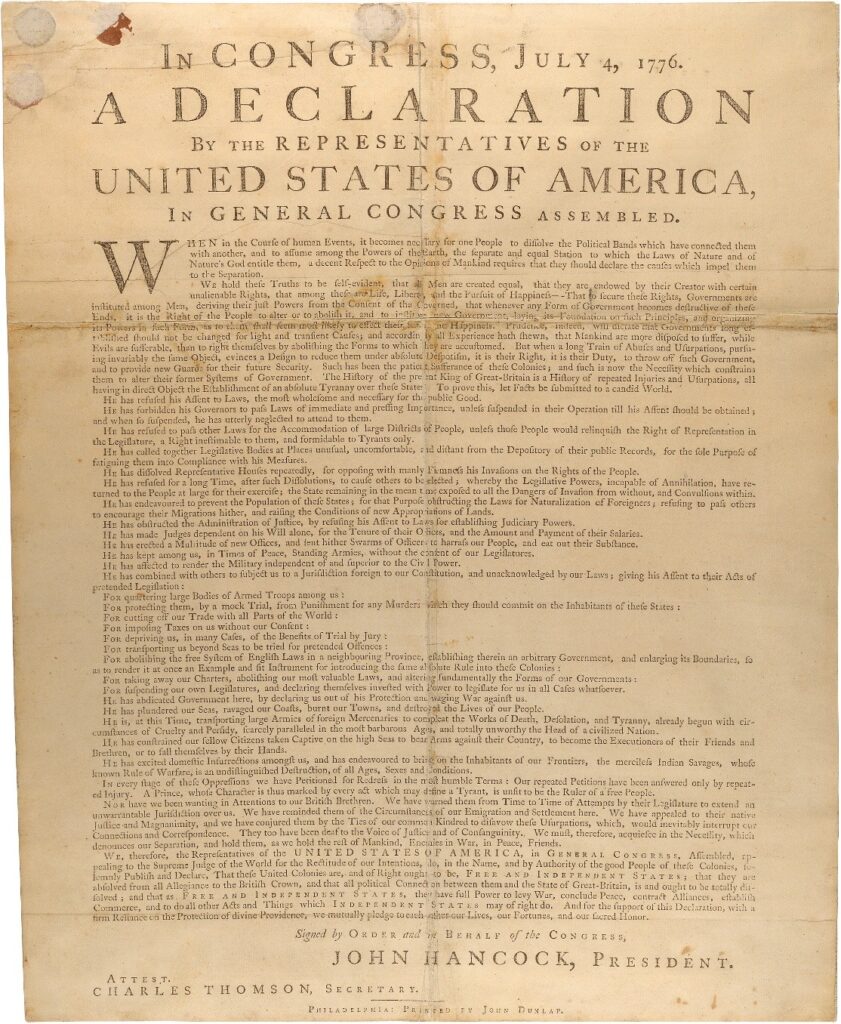
The Dunlap Broadside was the first published edition of the United States Declaration of Independence, printed on the night of July 4, 1776, by Philadelphia printer John Dunlap. Copies of this were sent out to the states for distribution and reading.
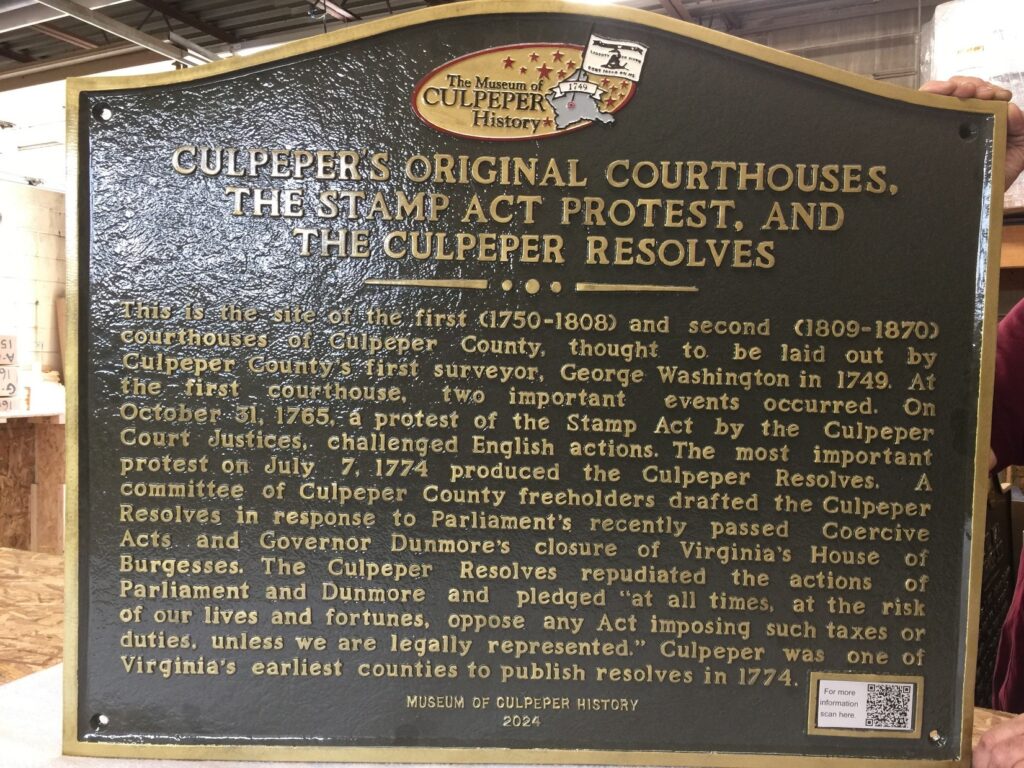
The historical marker currently on the Pepperberries building along Main Street in Culpeper, Virginia.