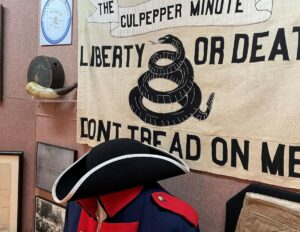
Culpeper Minute Men: Icons of Independence
Culpeper County and the Revolutionary War: An Overview of Importance
Written By: Jim Bish
As we approach the upcoming 250th anniversary of the Declaration of Independence, residents of Culpeper County have reason to be proud of the Patriots and residents of 250 years ago. Their efforts created America and they created changes that are still impacting today’s world.
Leading up to the Revolution
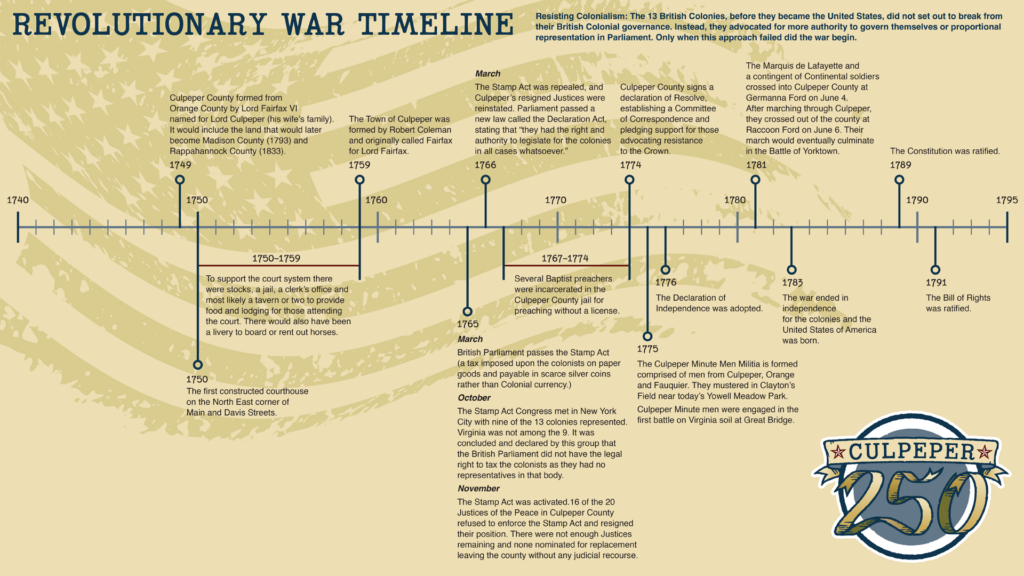
First of all, on the onset of this county’s existence in 1749, Culpeper County justices appointed as their first county surveyor a young (17 years old) man George Washington with no experience to hold that office. Washington, who proudly signed his first-ever public work, a survey conducted on July 22, 1749 as Surveyor of Culpeper County. The survey was located just south of Brandy Station, where Washington earned £2 and 3 shillings payment for his first professional work. This same George Washington led Virginia’s efforts in the French and Indian War as the Colonel of the Virginia Regiment which included many men from Culpeper. On June 15, 1775 Washington was selected to command the Continental Army which he led throughout the entire war to victory in 1783. In 1788 Washington was unanimously selected as the first United States President. Washington retired to Mount Vernon after completing his second term as president in 1797 ending a public career which lasted 48 years. It was Culpeper, however, which gave him his first professional opportunity.
In 1765 Culpeper County was one of less than five of Virginia’s counties which staged an organized protest against the Stamp Act when sixteen of our twenty justices resigned their office rather than enforce the measures of the Stamp Act. Their actions aided in bringing about the repeal of the Stamp Act in 1766. Eight years later in 1774, Culpeper County joined at least forty-four other counties in writing local resolutions of grievances against Great Britain. Culpeper was the first Virginia county to protest the importation of slaves stating, “that the importing of slaves and convict servants, is injurious to the colony, as it obstructs the population of it with freemen and useful manufacturers, and that we will not buy any such slave or convict servant hereafter to be imported.” Culpeper was one of only three counties to declare “that we will at all times, at the risk of our lives and fortunes, oppose any act imposing such taxes or duties.”
The Onset of War
When fighting broke out between the American Patriots and the British and their American Loyalist, Culpeper’s Patriots, were the first Virginians to organize, drill, and to deploy as a regular company and as a minute battalion. Culpeper’s readiness was certainly unusual for the time which led to their indispensable role in the defense of Hampton, the Battle of Great Bridge, and the occupation of Norfolk which eventually led to the evacuation of Virginia by Royal Governor Dunmore and his British and Loyalists forces. The removal of Dunmore’s forces by the summer of 1776 led directly to Virginia proclaiming independence from Great Britain on May 15, 1776. On that day, the delegates of the Fifth Virginia Convention including Culpeper’s delegates French Strother and Henry Field, voted unanimously to instruct Virginia’s delegates to the Continental Congress, “to declare the United Colonies free and independent states absolved from all allegiance to or dependence upon the crown or parliament of Great Britain.” To that point, no state legislature had taken the final step of instructing their delegates to propose independence by their colonial leaders on a path that ended with separation from Great Britain and the birth of the United States in July 1776.
After the liberation of Virginia from both British military and political power in the summer of 1776, Culpeper’s military leaders shifted from Minute Battalion service to Continental service. Culpeper’s Patriots fought in every major campaign of the Revolution from 1776 through to 1781. This included action in the New York Campaign (August 26 – November 16, 1776), Crossing the Delaware (December 25-26, 1776), Battles of Trenton (December 26, 1776), Princeton (January 3, 1777), Brandywine (September 11, 1777), Germantown (October 4, 1777), Valley Forge winter (1777-1778), Monmouth (June 28, 1778), and the Siege of Charleston (March 29 and May 12, 1780), Waxhaws Massacre (May 29, 1780), Battle of Camden (August 16, 1780), Battle of Kings Mountain (October 7, 1780), Battle of Cowpens (January 17, 1781), Race to the Dan (February 1781), Battle of Guilford Courthouse (March 15, 1781), Battle of Eutaw Springs (September 8, 1781), and Yorktown (October 1781). Culpeper’s most important Revolutionary military leaders included General Edward Stevens, Colonel John Green, Colonel John Jameson, Colonel Abraham Buford, Major Gabriel Long, and Major George Slaughter. Most of Culpeper’s military leaders and patriots marched off Clayton’s “Old Field” muster site in Culpeper during October 1775 and six years later witnessed the surrender of Cornwallis at Yorktown in 1781.
The Revolutionary War comes to Culpeper
Other important Revolutionary Culpeper events included the passage of almost 4,000 British and Hessian troops captured following the Battle of Saratoga in New York through Culpeper in January 1779 on their way to Charlottesville, Virginia. Known as the Convention Army after the instrument of their surrender, the troops constituted the largest number of enemy prisoners in America’s history. In the final months of the war the General Marquis de Lafayette, with roughly 3,000 Continental soldiers and militia, camped in Culpeper County two days (June 4-6, 1781) while trying to meet up with General Anthony Wayne’s roughly 1,000 Pennsylvania troops. Wayne’s troops marched through Culpeper on June 8-9th and his forces combined with those of Lafayette just south of Culpeper on June 10. Once united Lafayette and Wayne were able to push British General Lord Cornwallis and Major Banastre Tarleton’s forces toward Yorktown resulting in the culminating battle of the war.
Culpeper’s Patriots gained Independence and contributed to a New World existence
Culpeper County has real connections with the most important leader of the Revolution, George Washington, and the most important foreign leader of the Revolution, Marquis de Lafayette. Culpeper’s Patriots helped to bring about the world’s first democratic republic, setting an example to overthrow both monarchy and colonial governments. While Culpeper’s Patriots gained independence while offering a new vision for the future Americans, it had a much larger worldwide impact. The American Revolution inspired revolutions which worldwide since 1776 has influenced over 100 independence movements while establishing over 150 democratic-republican governments. The United States has the world’s oldest written constitution, which was used as a model in other countries, sometimes word-for-word. America’s Revolution started it all. The American Revolution helped to ignite the worldwide abolition movement. Before the Revolution there was no meaningful antislavery movement in the American Colonies or Great Britain. But during the Revolution and in its aftermath nine states (Pennsylvania, New Hampshire, Massachusetts, Connecticut, Rhode Island, New York, New Jersey including the new states of Vermont and Ohio), either abolished slavery outright or set it on the road to extinction through gradual abolition statutes. Congress limited and then banned the African Slave Trade, and active antislavery movements emerged in all the Northern states. These states also began to protect the civil and political rights of free African Americans, who voted, participated in public life, and even on a few occasions, held public office. Culpeper’s Patriots aided in doing all of this and are worthy of a great celebration 250 years later.